Yes, we set up restrooms for orchards, hay crews and dairy operations across Spokane Valley, and federal rule OSHA 1928.110 requires one field sanitation facility per 20 hand-labor employees, reachable within a quarter mile walk. A standard unit runs 150 to 500 dollars a week depending on service frequency and distance from town.
If your crew does hand labor, whether that is picking, thinning or packing, OSHA 1928.110 sets the baseline: potable water, a toilet facility and a handwashing setup for every 20 workers, and none of it more than a quarter mile from where people are working. That is different from a construction job, which falls under OSHA 1926.51(c) instead. Most Spokane Valley operations run crews spread across several fields at once, so you are usually looking at more than one portable toilet rental placed at different pull-off points rather than one bank of units at the barn. A handwashing station rental has to sit next to each toilet, and under 29 CFR 1910.141(d)(2), soap and a way to dry hands are required. Hand sanitizer alone does not satisfy that standard, so do not swap one in and call it done. If your operation is spraying herbicides or insecticides, OSHA 1926.51(f)(1) kicks in too, requiring washing facilities wherever those chemicals are applied. We move units as the harvest moves, which matters more out here than it does on a fixed job site. A gravel pull-off near an orchard row one week might be a stubble field the next, and your restroom plan should shift with it. For crews near Liberty Lake, about 7.0 miles east of Spokane Valley, or out toward Otis Orchards-East Farms, 10.3 miles northeast, we plan delivery routes around actual field access, not just the address on the lease.
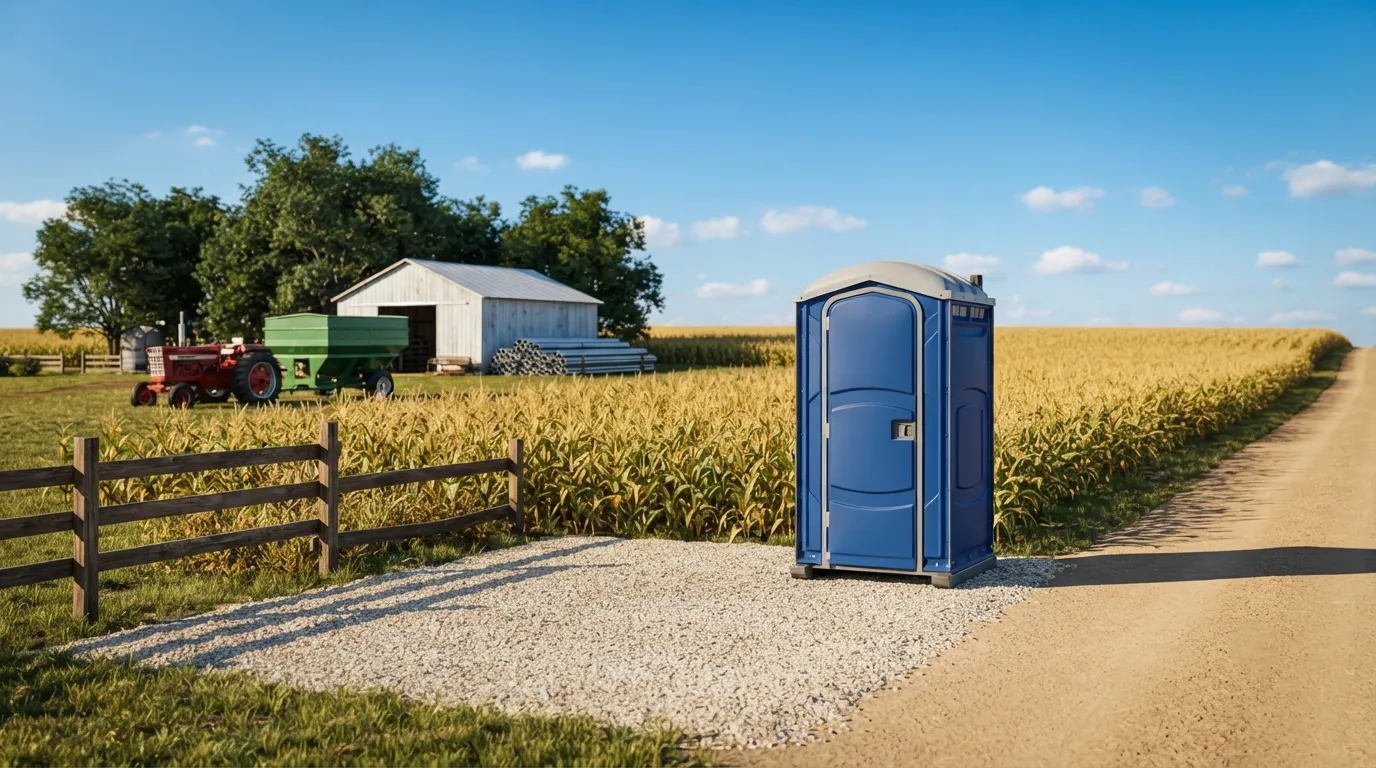
Start with your peak crew size, not your average one. Twenty hand-labor workers means one facility minimum under OSHA 1928.110, and that math does not care whether the other 19 are only there three days a week during harvest push. A lot of Spokane Valley growers underbuy for the two or three weeks a year when seasonal labor doubles, then scramble. Our how many porta potties do I need guide walks through crew-size math if you want to run your own numbers before calling. For scattered field work, we favor several standard porta potty rental units at separate access points over one large cluster at the main yard, since the quarter-mile walk limit is measured from wherever people are actually working, not from the farmhouse. If you run a dairy or have year-round staff on-site, a monthly porta potty rental at a fixed spot near the parlor makes more sense than moving units weekly. Ranches running crews near Millwood, 4.6 miles northwest, sometimes combine field units with a fixed unit at a staging yard, and we can quote both in one delivery run. If any of your workers have mobility limits, ADA Standards section 213.2 requires at least one accessible unit in any cluster, even a small one, and we stock those specifically for farm accounts.
Yes, and this is most of what we do out past the edge of paved Spokane Valley roads. Our trucks handle gravel and dirt access fine, but we do need a path in and enough room to turn around, since a stuck service truck helps nobody at 6 a.m. during harvest. Units themselves need no power or water hookup; each standard toilet carries its own 60 to 70 gallon holding tank, and service intervals follow ANSI/PSAI Z4.3, which sets one weekly visit as the baseline for lighter use. Heavy harvest crews often need twice-weekly service instead, and we adjust the route once we see actual usage. If your fields sit far enough out that a same-day fix would be tough, our emergency porta potty rental line covers a tank that fills faster than expected or a unit that gets knocked over by equipment. For larger operations running bunkhouses or seasonal housing, a restroom trailer rental gives crews something closer to a real bathroom, with running water built in rather than a holding tank alone. We also handle septic on the property side. If your farmhouse or bunkhouse runs on a private system, septic pumping service and how often to pump a septic tank cover the maintenance side, and a residential tank typically needs pumping every 3 to 5 years depending on tank size and household count.
A standard unit runs 130 to 500 dollars a week depending on service frequency, and monthly rates for fixed placements run 125 to 325 dollars. Field jobs with multiple pull-off locations cost more per unit than one central cluster. See porta potty rental cost for a full breakdown by duration.
Yes. A handwashing station rental can be ordered on its own or paired with any toilet order, and 29 CFR 1910.141(d)(2) requires soap and towels or a dryer, not sanitizer alone, for compliant handwashing.
Tell us your peak number, not your average. We can add or pull units as harvest ramps up or slows down, and short-notice swaps are common this time of year across Spokane Valley farm accounts.
Yes, plenty of our farm stops are described by a gate code or a landmark rather than a street number. Give us GPS coordinates or a description and we will find it.
Yes, we run routes out to Liberty Lake, Millwood and Otis Orchards-East Farms. Check service areas for the full coverage map or request a quote with your location.
Yes. Spokane Valley Porta Pros delivers farm and agricultural restrooms across Spokane Valley and the surrounding metro, with same-day and next-day drop-off available on most orders.
Pricing depends on the unit and how long you need it. See our cost breakdown and request a free quote for an exact figure.
Standard rentals include scheduled service — a pump-out, a clean, a restock and fresh deodorizer. Busy or hot-weather sites can be serviced more often.
Call now or request a free quote — clean units, on-time delivery, transparent pricing.