A county fair pulling a few thousand people a day needs restrooms sized to peak attendance, not average attendance. Plan on one standard unit per 200 to 300 guests for a single afternoon, plus at least one ADA unit per cluster under ADA Standards section 213.2. Spokane Valley Porta Pros builds the count around your gate estimate, not a guess.
Start with your projected daily attendance, then work backward. A fairground drawing 3,000 people a day is a different math problem than a two-day 4-H show drawing 400. OSHA 1926.51(c) sets construction-site ratios, and fair organizers in Spokane Valley often use that same table as a planning floor: one toilet for every 20 workers on setup and teardown crews, then a separate, larger count for public attendance once gates open. Most fair layouts split the grounds into zones, food court, midway, livestock barn, grandstand, and put a restroom cluster in each. That beats one giant bank of units by the main gate, because it cuts walk time and keeps lines from backing into vendor aisles.
Standard units run $100 to $350 a day depending on cluster size and service frequency, with weekend and multi-day fair rates typically landing in a wider band shown on our event restroom rental page. For a fair pulling family crowds with strollers and elderly visitors, add deluxe flushable units near the grandstand and at least one ADA accessible porta potty per zone, sized to the 60 inch turning circle required by ADA Standards section 304.3.1. If your fair runs a livestock or 4-H component, check our farm and agricultural restrooms page too, barn crews and public foot traffic need separate service schedules.
| unit | day | weekend | event |
|---|---|---|---|
| standard | $100 - $350 | $125 - $400 | $200 - $800 |
| ada | $200 - $400 | $199 - $300 | - |
| deluxe | $85 - $1,200 | - | - |
| restroom trailer | $175 - $2,500 | $900 - $3,000 | $2,499 - $3,899 |
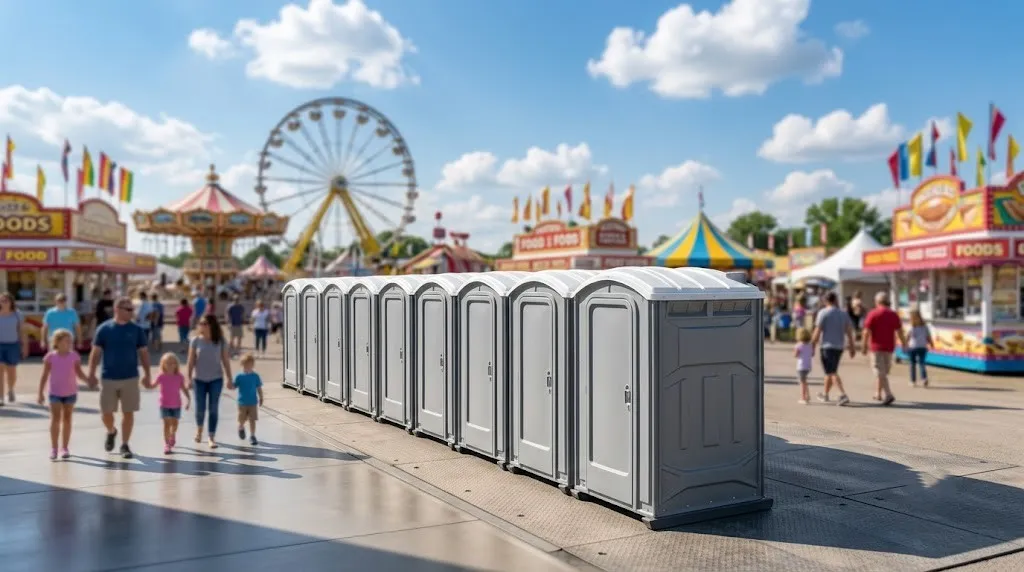
Placement decides whether your fair runs smooth or backs up at the gate. Units belong on stable, level, slip-resistant ground per ADA Standards section 302.1, away from tent stakes, generator cables and food truck grease traps. A grease interceptor at a fair food court gets pumped once fats, oils, grease and solids hit 25 percent of the liquid depth, so if you are running a concession row, pair your restroom order with a grease trap pumping plan rather than treating it as an afterthought. Delivery trucks need roughly 60 feet of straight clearance to drop a roll-off or a restroom trailer, so walk your fairground layout before delivery day and flag any tight turns near barns or grandstand ramps.
Accessible routes between clusters need a minimum 36 inch clear width under ADA Standards section 403.5.1, which matters on packed midways where vendor tables creep into the walkway. Door openings on ADA units meet a 32 inch minimum per ADA Standards section 404.2.3, wide enough for most mobility devices if the approach path stays clear. For fairs running past dusk, night livestock checks or a lit midway, pair your restroom order with a light tower rental near each cluster; OSHA 1926.56(a) sets illumination minimums for work areas, and organizers use the same standard informally for public paths after dark. If your fairground sits close to Liberty Lake or Otis Orchards-East Farms, both within a short drive of Spokane Valley, we run the same trucks out to those grounds without a separate mobilization charge.
Yes, especially near food vendors and livestock barns. A standalone handwashing station rental or portable sink rental near the food court keeps lines moving and keeps grease and animal contact away from the restroom queue. Handwashing setups need soap and towels or a hand-drying device under 29 CFR 1910.141(d)(2); hand sanitizer alone does not satisfy that standard, so do not swap one for the other at your food vendor row. If any part of your fair involves spray painting signage, staining fence rails or treating livestock pens with insecticide, OSHA 1926.51(f)(1) requires washing facilities for that specific work, separate from general public sanitation. Spokane Valley fair organizers who run both a barn area and a public midway usually order two handwashing tiers: heavy-duty stations for crew and vendors, lighter hand sanitizer station rental units for casual foot traffic near the grandstand.
Book as soon as your gate count firms up, ideally 60 to 90 days out for a multi-day fair. Fairground season books fast across the region, and clusters near food courts or grandstands go first. Waiting until two weeks out limits your unit selection.
Yes. A restroom trailer rental works well for grandstand VIP sections or sponsor tents. Our 4 stall restroom trailer and 8 stall restroom trailer options both flush and run cleaner than standard units for multi-day events.
Placement in a public right of way needs confirming with the city; fairground property under a private or county lease may have its own rules. Check with fairground management and see our porta potty permit requirements page before finalizing your layout.
Daily servicing is standard for public events with heavy traffic. ANSI/PSAI Z4.3 sets a baseline of one weekly service for lighter use, but a fairground pulling thousands daily needs servicing every day, sometimes twice.
Call us. Spokane Valley Porta Pros keeps standby units for exactly this, and we can often deliver additional standard or ADA accessible porta potty units same-day if your fair runs into an unexpected crowd.
Yes. Spokane Valley Porta Pros delivers county fair restrooms across Spokane Valley and the surrounding metro, with same-day and next-day drop-off available on most orders.
Pricing depends on the unit and how long you need it. See our cost breakdown and request a free quote for an exact figure.
Standard rentals include scheduled service — a pump-out, a clean, a restock and fresh deodorizer. Busy or hot-weather sites can be serviced more often.
Call now or request a free quote — clean units, on-time delivery, transparent pricing.