Spokane Valley Porta Pros gets sanitation on the ground fast when a wildfire, flood or windstorm knocks out plumbing. Standard units run $100 to $350 a day, and delivery within a 7.0 mile radius of Liberty Lake or 4.6 miles of Millwood can move quickly once a site is cleared. Call, tell us the headcount, and we go.
When power or water goes out, the clock matters more than the paperwork. We keep standard porta potty rental units staged and ready, and our emergency porta potty rental line exists for exactly this situation: no waiting for a normal quote cycle. A relief site in Spokane Valley with displaced households needs toilets within hours, not days, and OSHA 1926.51(c) sets the baseline we plan around: one toilet for every 20 people on a working site, scaling up from there. Disaster shelters aren't construction sites, but the ratio still tells you how fast a small crowd overwhelms a single unit. If the event knocks out a lift station or a septic system, emergency septic service and septic pumping service can run alongside restroom deliveries so gray water and sewage don't back up into shelter space. We also carry handwashing station rental units and portable sink rental setups, since 29 CFR 1910.141(d)(2) requires soap and towels at any hand-washing point, not sanitizer alone. For a command post or triage tent, a portable restroom rental with a lock and a temporary fence rental around the perimeter keeps the area orderly when a lot of people are moving through unfamiliar ground in the dark.
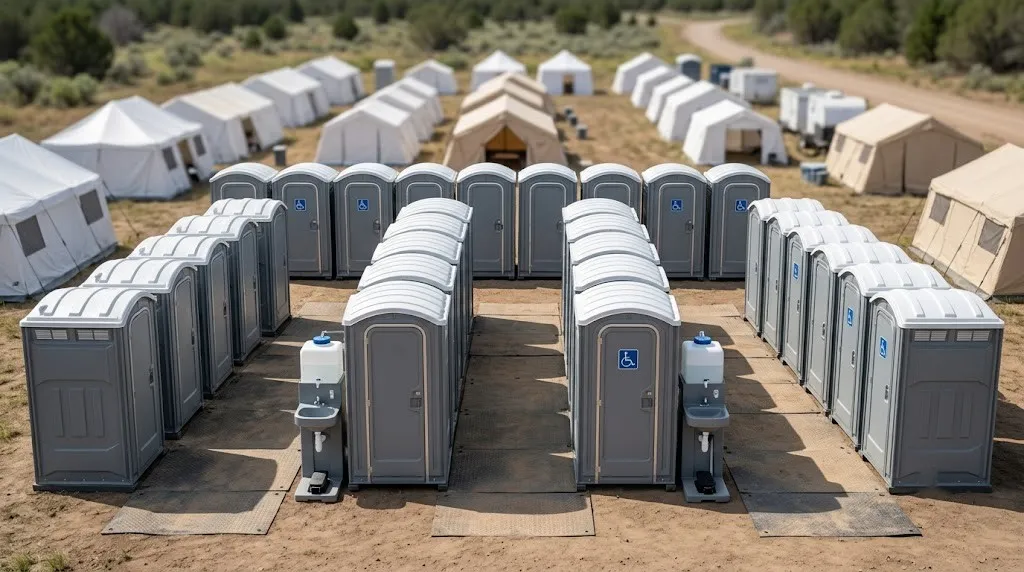
It depends on scale. A neighborhood-level outage might need two or three porta john rental units and a handwash station. A county-coordinated shelter, the kind that might stand up near Otis Orchards-East Farms 10.3 miles northeast of Spokane Valley, needs a real deployment: multiple standard units, at least one ADA-compliant unit under ADA accessible porta potty, and often a restroom trailer rental if the shelter runs more than a few days. ADA Standards section 213.2 requires that at least 5 percent of clustered single-user units be accessible, with a minimum of one, and that unit needs a 60 inch turning circle under section 304.3.1 so a wheelchair can maneuver inside. We also bring light tower rental units for after-dark visibility and a temporary power pole when the shelter's own power is down, since OSHA 1926.56(a) sets minimum lighting levels for work areas and a dark path to a toilet is its own hazard. For sites that need debris hauled out fast, a roll-off dumpster rental clears storm debris, and what cannot go in a dumpster is worth checking before hazardous material ends up mixed with regular waste. If displaced families need secure storage for salvaged belongings, a storage container rental or 20ft storage container holds what a tent can't.
Placement matters as much as speed. A relief site is often improvised: a parking lot, a fairground, a church lawn. ADA Standards section 403.5.1 calls for a 36 inch clear path to any accessible unit, and section 405.2 caps ramp slope at 1:12, so a unit set on a curb or a slope without a landing pad fails the same standard a construction site would. Our porta potty placement guide walks through firm, level ground requirements that apply whether it's a job site or a shelter lawn; ADA section 302.1 requires the surface itself be stable and slip resistant, which matters more in Spokane Valley's mud season than most people expect. A roll-off delivery, if debris removal is part of the response, needs about 60 feet of straight clearance behind the truck, so tight shelter lots sometimes need a second drop point. If the disaster affects a farm or agricultural operation near Spokane Valley, our farm and agricultural restrooms page covers OSHA 1928.110, which sets field sanitation rules at one facility per 20 workers within a quarter mile walk. For longer relief operations we recommend reviewing how many porta potties do i need and osha portable toilet requirements before the second wave of equipment arrives, since undercounting on day one usually means a rushed second delivery on day three.
Standard units run $100 to $350 a day depending on volume and duration, per our porta potty rental cost page. Weekend response often runs as a flat surge rate rather than a per-day rate, so ask when you call. Multi-day relief operations should ask about monthly porta potty rental pricing if the response stretches past two weeks.
Yes. Disasters don't wait for business hours, and neither do we. Call Spokane Valley Porta Pros directly rather than submitting a standard request a quote form when the situation is active and time-sensitive.
Yes, we stock ADA units built to section 213.2 and 304.3.1 standards. Shelters serving elderly or disabled residents should request these first, since they're often the scarcest unit type during a large-scale response.
We run septic tank cleaning and pumping alongside restroom delivery. A typical 1,000 gallon residential tank is pumped every 3 to 5 years normally, but flooding or overload can force an off-cycle pump-out immediately.
Yes. We've mapped real distances to Millwood, Liberty Lake, Otis Orchards-East Farms, Post Falls and Coeur d'Alene; check service areas for the closest deployment point to your shelter or command post.
Yes. Spokane Valley Porta Pros delivers disaster relief sanitation across Spokane Valley and the surrounding metro, with same-day and next-day drop-off available on most orders.
Pricing depends on the unit and how long you need it. See our cost breakdown and request a free quote for an exact figure.
Standard rentals include scheduled service — a pump-out, a clean, a restock and fresh deodorizer. Busy or hot-weather sites can be serviced more often.
Call now or request a free quote — clean units, on-time delivery, transparent pricing.